
Aims and scope of the course
The scope of the course is to present relevant state-of-the-art research and best practices for design and assessment within the field of structural concrete. The course covers several selected topics, ranging from theoretical principles, conceptual design of structures and advanced numerical modelling.
The main objectives of the course are:
- To have an overview of structural theories applicable to the design and analysis of reinforced concrete, including plasticity theory, graphic statics, fracture mechanics and energy principles
- To understand the concept of limit state design and the related safety format
- To have an insight into the prerequisites for a safe and sound application of plasticity-based approaches to structural concrete
- To understand and to apply through assignments advanced numerical tools as:
- Finite Element Limit Analysis (FELA) to design and to verify structural concrete elements at Ultimate Limit State
- Finite Element Serviceability Analysis (FESA) to evaluate the serviceability behaviour of reinforced concrete structures
- Elastic-Plastic Stress Fields (EPSF) for design and assessment of structural concrete
Credits, Dates and Fee
Micro-credential UPM: 2.5 ECTS
Dates: May 18th-22nd 2026
Course Fees: 400 Euros (Including light lunches and one dinner)
DTU/UPM collaboration
This course is given on even years (once every two years) as a joint initiative between DTU (Technical University of Denmark) and Universidad Politécnica de Madrid. An equivalent course is given by Profs Linh Cao Hoang and Peter Noe Poulsen at DTU (Denmark) in odd years.
Content
The course is structured around lectures and practical exercises covering both analytical and numerical approaches. In the exercises, students will work with analytical models, MATLAB/python code and existing software programs, focusing on the design and assessment of practical cases.
The lectures will cover topics such as:
- Concepts of limit state design and safety.
- The theory of plasticity and the fundamental theoretical basis for the formulation of numerical modelling of concrete structures.
- Convex optimization methods and description of the corresponding FEM formulation to optimize the collapse load.
- Energy principles for elastic structures and description of the corresponding optimization-based FEM formulation for service limit state analysis
- Non-linear fracture mechanics and behaviour of cracked structural concrete
- Displacement-based FEM formulations and the application to fully cracked concrete structures.
- Considerations on serviceability limit state and cracking of structures
- Reliability concepts and application within the frame of limit analysis
Programme, schedule and evaluation
| Session | MO | TU | WE | TH | FR |
| Theory 1 | Design and Assessment | Fracture Mechanics | Concrete plasticity | Cracked response | Safety format |
| Theory 2 | Limit analysis & Energy principles | FELA – trusses | FELA – 2D | EPSF | FELA-3D |
| Theory 3 | Strut-and-tie /stress fields | FESA – trusses | FESA – 2D | EPSF | FESA-3D |
| Practice | Discussion of assignments | ||||
Evaluation grade upon attendance to courses and participation in assignments
Social Events
On May 18th: Ice-breaker on Retiro campus with Pizza and drinks
On May 22th: Social activity (to be announced)
Professors
Responsible
Prof. Dr Alejandro Enfedaque (alejandro.enfedaque@upm.es)
Escuela Técnica Superior de Ingenieros de Caminos, Canales y Puertos
Universidad Politécnica de Madrid
Campus Ciudad Universitaria, Calle del Prof. Aranguren, 3, ES-28040 Madrid, Spain
Lectures:
Miguel Fernández Ruiz (UPM)
Alejandro Enfedaque (UPM)
Linh Cao Hoang (DTU)
Peter Noe Poulsen (DTU)
Venue
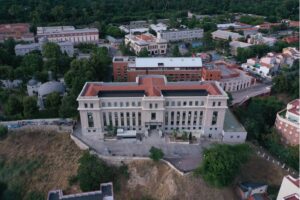
Escuela Técnica Superior de Ingenieros de Caminos, Canales y Puertos – Edificio Retiro
C. de Alfonso XII, 3, y 5,
ES-28014 Madrid (Spain)
Disclaimer
The information presented in this webpage may still suffer changes until formal inscription dates and deadlines are confirmed. For any question, please contact Miguel Fernandez: miguel.fernandezruiz@upm.es